
Focus on brand or performance?
Birgit

Performance and immediate results, or building a strong brand in the long term? Often these two are viewed as separate silos, while the power actually lies in their integration. This is also confirmed by recent WARC research. But why does an integrated approach work best? And what does that mean concretely for your choices?
Performance: immediate results with a ceiling
Research and practice show time and again that performance campaigns deliver fast, measurable results. But there is a limit to what they can do. Based on the 95/5 rule, usually only 5% of the target audience is active in the market. A performance campaign barely reaches the rest. WARC even warns of the advertising doom loop:
Advertising ROI flattens out
Optimizing metrics that are incorrect or too short-term
Budget shifts even more towards performance formats... causing the effect to decline even further.
As Binet & Field have also shown before: performance works quickly, but has a ceiling and collapses immediately once you stop. That is why you also need emotion, recognition, and brand building.
Building brands: the foundation of growth
Your customers shouldn't just feel something for your brand when they are in the market, but also when they are out of it. Building brands takes time and must be done consistently, but it yields both short- and long-term results. Cutting too much branding to shift budget to performance can be harmful. Not only for your brand awareness, but even for your performance.
Brands × Performance
Strong brand equity accelerates performance. If potential customers already know your brand and have positive associations with it, they choose faster when they see a performance ad. Conversely, performance ads reinforce brand association when someone has a good experience. So it works both ways and not just in the long term. Clear effects are also visible in the short term.
Budget allocation: how to do it?
Then the question everyone asks: how is it best to allocate your budget? The guidelines:
At least 30% to branding; optimally 40–60%
→ This feeds your 'brand multiplier': your brand works harder for your performance.Reduce SEA budgets where possible.
→ Search engines often distort the picture due to last-click attribution.
→ Advice: max. 25% of your total budget should go to search.
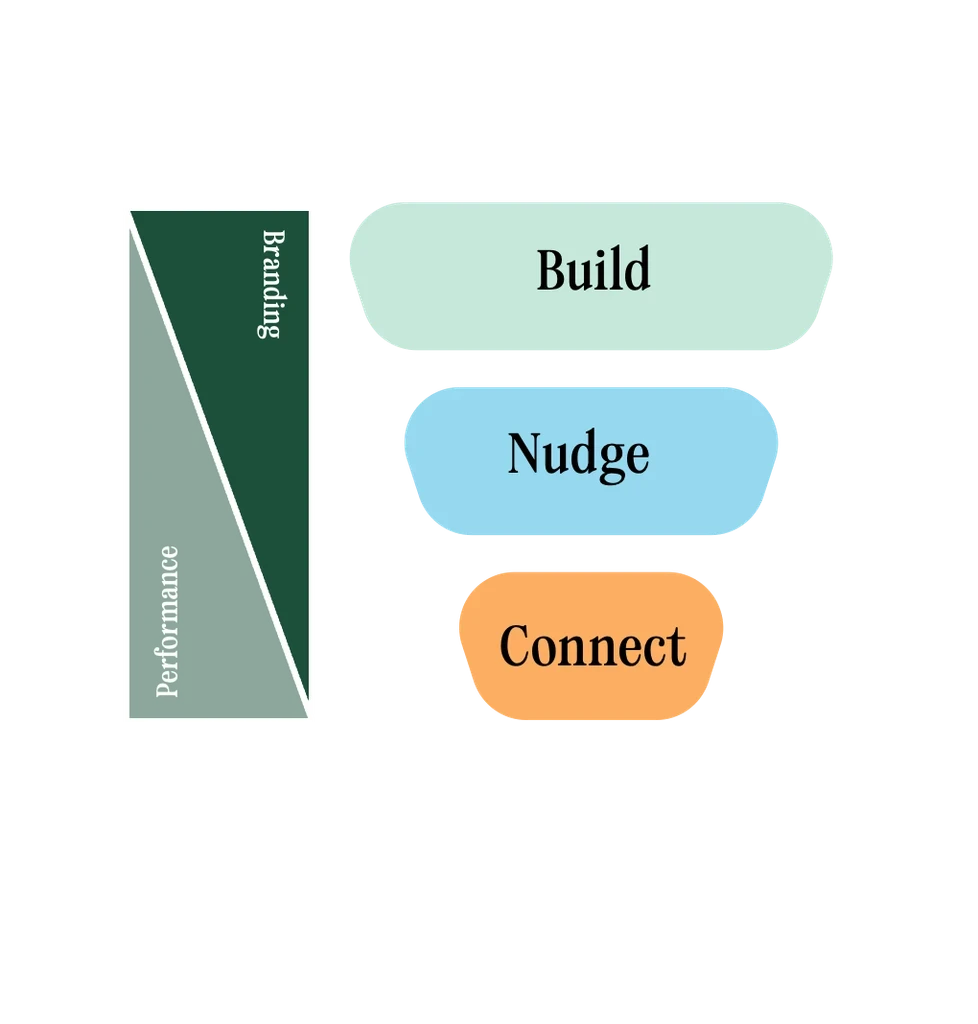
Build, Nudge, Connect
Almost every channel contains both branding and performance. The difference lies in the weight per medium. The combination makes campaigns most effective. Therefore, think less in funnels, and more in three movements:
Build — Build your brand (recognition, emotion, memory structures)
Nudge — Prompt behavior (encourage, activate, provide direction)
By looking at it this way, branding and performance are no longer separate silos, but one single system that reinforces each other. Ready to make the connection?