
NMO Media Trends 2023
Birgit

In a world where every household is packed with devices, it is no surprise that we are more connected than ever. But how has this digitalization influenced our media behavior in 2023? Let's dive into the figures of online consumption, reading habits, and changing viewing and listening patterns.
Online: A mixed picture
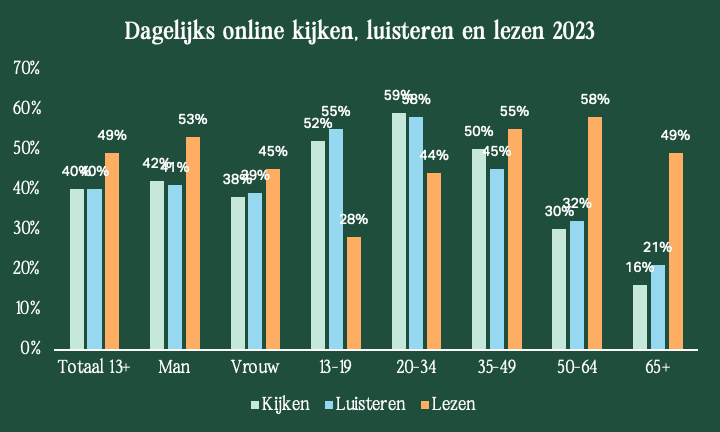
Online we are still very active, listening is increasing, viewing remains stable, but reading is slightly declining. This raises questions about the changing nature of our online interactions. Men seem to go online slightly more often than women, in both reading, viewing, and listening habits. Interestingly, but not unexpectedly, different age groups have different preferences: older people tend more towards online reading, while younger people (34 and under) prefer listening and viewing.
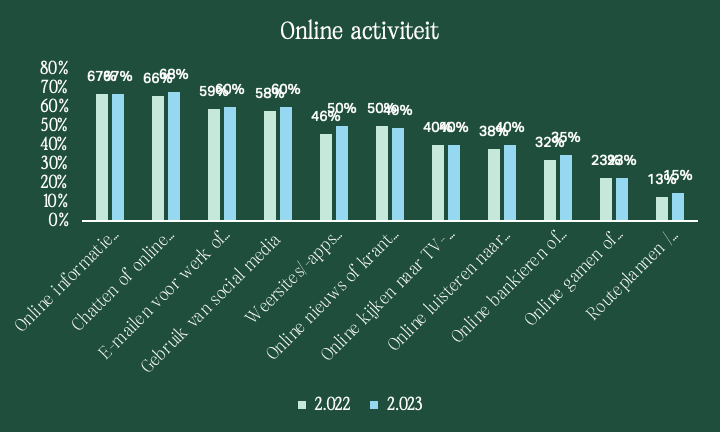
The digital space is primarily used for chatting/video calling (68%), followed by receiving information for 67% of Dutch people, and emailing (60%). It is clear that younger people are more engaged in chatting, while the 35+ group focuses more on online news. Youth (13-19) are highly active in online gaming, while email remains popular among adults, in line with the working population.
Reading in a digital era
With a slight decrease in all forms of reading compared to 2022, Saturday remains the peak day for daily newspaper consumption. Interestingly, despite the overall decline, digital reading habits for daily newspapers and magazines have increased. It seems that the reader community is becoming more divided between strictly digital and strictly physical preferences.
Viewing: Changing Patterns
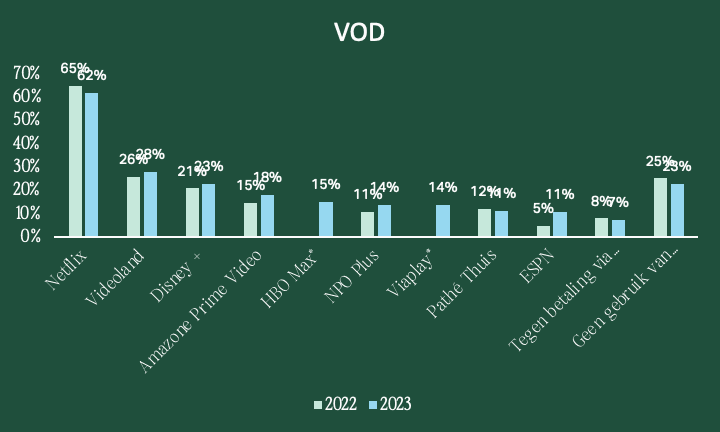
Watching television via the TV screen has seen a slight decline, mainly due to a decrease in live TV viewing, as also discussed in detail in the blog about TV screen time. Despite this, shows like "Wie is de Mol?" and "Heel Holland Bakt" remain enormously popular. Among paid video services, we saw an interesting shift; Netflix remains the leader, despite a small decline, while Videoland saw an increase in users. Striking is the growth in the number of households using multiple VOD services, indicating a diversification in the viewing landscape.
Listening: Podcast continues to grow
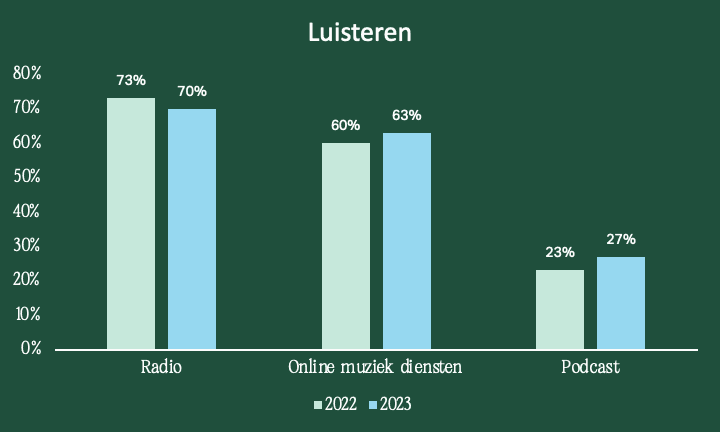
While radio is still the most popular for listening behavior, we see a growth in the popularity of online music services and podcasts, especially among the younger demographic. Spotify (56.6%) remains the most used platform for music streaming. Podcasts are gaining ground, with a strong preference in the 20-34 age group. In the 35-49 age group, however, podcast listening is increasing the most.
Media behavior in 2023 illustrates a diverse and changing landscape. While some traditions endure, such as the Saturday newspaper, we see a clear shift towards more digital and fragmented media consumption. Therefore, it will become even more important to use the right channels to reach your target group. Although they still appear everywhere, it is in many cases less clear-cut. Naturally, we are happy to help with this!
Also interesting